Competition
Articles

The Heart of Townsville: How a Community Workshop, a Window Washer, and a Whole Lot of Stubborn Optimism Are looking to rewrite and reinvent the Story of Our CBD
There are over 5,000 people sleeping within a stone's throw of Bulletin Square every single night. More than 11,000 workers pour in every weekday morning. And yet somehow, a decent chunk of them still manage to scurry between their car park and their office without stopping for so much as a sandwich. Townsville, we need to talk about our CBD.
In early 2025, the Townsville Chamber of Commerce did something that would have sounded a bit nuts if you'd pitched it in a boardroom. Instead of commissioning another consultant's report or waiting for another tier of government to wave a magic wand, they launched a grassroots initiative called UpTown Townsville and invited a high school dropout from Brisbane to help them figure out how to bring the CBD to life.
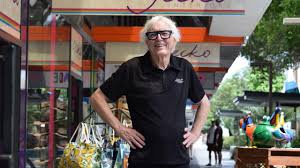
David Engwicht. is one of the world's most celebrated thinkers on public spaces but he started out washing windows for a living. His life changed in 1987 when he accidentally attended a public meeting about a road widening through his neighbourhood, got fired up, and ended up on the protest committee. From there, he taught himself urban design by calling experts around the world and reading every book he could find. He went on to create the Walking School Bus (yes, the actual concept), write multiple books that changed how cities think about streets and public spaces, and develop a methodology called the 7 Day Makeover that has transformed tired town centres on shoestring budgets across Australia, New Zealand, the UK, and the United States.
The Project for Public Spaces in New York calls him "one of the world's most inventive thinkers on creating vibrant public spaces." His philosophy is disarmingly simple: stop planning. Start doing. Work with what you have, not what you wish you had. And for heaven's sake, stop spending all your money on reports that sit in drawers.
The Townsville Chamber, through UpTown, brought David to the city in March 2025 for a series of creative placemaking workshops. He came back again in June. And the things he found, and the ideas he sparked, are already changing how Townsville thinks about its city centre.
"Townsville has very good bones"
That was David Engwicht's assessment after walking the streets of Townsville's CBD. And he's right. But having good bones and being alive are two very different things. A skeleton has good bones. It's not exactly the life of the party.
So who's actually in the CBD? More people than you'd think.
3,625 residents live within 500 metres of Bulletin Square (ABS Census 2021). Add roughly 1,400 overnight visitors across the precinct's hotels and hostels on any given night, and you've got a combined residential and guest population of over 5,000 people before a single worker shows up.
Then the workers arrive. A 2012 Council stocktake counted 11,000 employees in the CBD. In 2025, Knight Frank Senior Partner Craig Stack confirmed the number is holding strong: more than 11,000 people working in the city centre, drawn from resources and renewables companies, health and NDIS providers, construction firms, and government agencies. Knight Frank's December 2024 survey found that Premium and A-grade office vacancy has dropped to just 4.85%, the lowest since the mid-1990s. (Good luck finding a desk with a view. They're gone.)
That's upwards of 16,000 people in the CBD precinct on any given weekday. In a city of 205,000, that's roughly one in every twelve Townsville residents physically present in the city centre on a normal day. But to walk past and watch the tumbleweeds and anti social behaviour you wouldn't think that is the case and that deters (and sometimes if being honest frightens) residents from coming in , investors from investing and
The question isn't whether anyone's there. They are. The question is: what happens when they get there? Do they linger, explore, spend, connect? Or do they get in, do their thing, and get out?
Danish architect Jan Gehl has spent fifty years studying exactly this question. His research, starting with Life Between Buildings in 1971, established something that sounds obvious but changed how cities think about streets: the longer people stay in a place, the more alive it becomes.
Gehl draws a distinction between three types of outdoor activity. Necessary activities (going to work, catching the bus) happen regardless of how good or bad the space is. Optional activities (grabbing a coffee, sitting in the sun, people-watching) only happen when the space invites them. And social activities (bumping into someone, having a chat, joining a crowd) only emerge when the first two are already happening.
Poor-quality spaces get the commuters and nothing else. High-quality spaces get all three layers stacking on top of each other, and that's when things start to buzz. More people lingering means more spending, more connection, more safety, and more reasons for other people to show up. It compounds.
A study published in 2025 used AI to analyse pedestrian behaviour in US public spaces across a 30-year period and found something alarming: walking speeds had increased by 15%, while the time people spent lingering had halved. People were treating streets as corridors, not places. The researchers warned this shift was eroding the community-building role of public spaces.
Meanwhile, cities that have deliberately invested in getting people to slow down and stick around are seeing results. Placer.ai's research on Sacramento's CBD found that when the city invested in programming, placemaking, and policy to create "social collisions" — reasons for people to show up, stay longer, and come back — event days produced measurably longer dwell times in surrounding retail areas. Sacramento went from a handful of annual events to over 200, and the foot traffic and revenue followed.
After the Times Square pedestrian plazas were created in New York, pedestrian injuries dropped, foot traffic jumped, and surrounding economic activity increased. Gehl's own research with the J. Max Bond Center found that 75% of visitors to new plazas in Queens and Brooklyn said they recognised or knew more people in their neighbourhood since the street was transformed.
The lesson for Townsville? Those 16,000 people are already in the CBD. The job isn't to attract a whole new population. It's to give the people who are already there a reason to slow down, look around, and engage with the streets. Every extra minute someone lingers on a footpath is another chance for a coffee, a conversation, a discovery, a reason to come back tomorrow.
Most cities, when they want to fix a struggling town centre, commission a masterplan. The masterplan costs a fortune. It takes years. It generates a beautiful document full of renders and aspirational language. And then it sits in a drawer.
We are not saying we do not need that. We absolutely do. Townsville needs all of that and all levels of government and industry support to do so. but that is not within Uptowns agency and control so we thought what can we do and that is where David Engwicht's approach was spot on and right for us right now. The principles are dead simple:
Work with what you have, not what you wish you had. Before a 7 Day Makeover, his team sets up a "Resources Bank" and finds creative uses for things already available. No wish lists. No fantasy renders. Just real stuff, right now.
Do more, talk less. His biggest criticism of traditional community consultation is that it generates "shared ignorance" because most people can only imagine their place being a pale imitation of somewhere else. Instead of endless workshops about what people want, he gets them out on the street actually doing things and learning from what happens.
Move from regulation to permission. During his Townsville visits, Engwicht recommended that Council adopt "permission statements" to let traders put goods, tables, and life out onto the street without jumping through bureaucratic hoops. Council listened. In 2025, Townsville City Council unanimously passed an Outdoor Dining and Footpath Activation Policy that scraps the need for specific permits for most businesses. For the first time, retailers (not just cafes) are actively encouraged to put their goods on the footpath.
What people do with their private land matters more than what happens in public space. A $10 million streetscape upgrade means nothing if every shopfront has its blinds down and its door closed. But a $50 sandwich board, some pot plants, and a couple of chairs on the footpath can completely change the energy of a block.
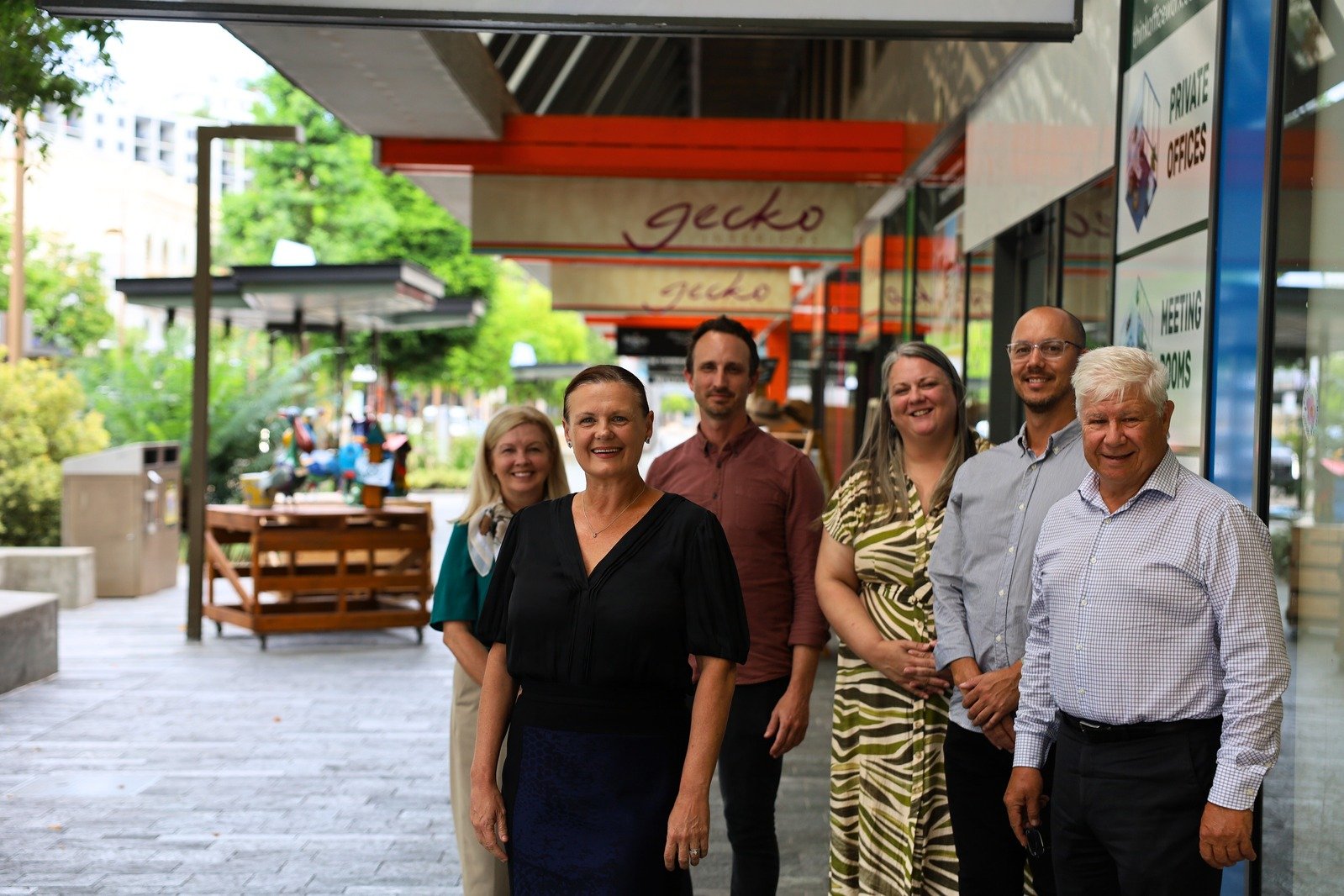
UpTown Townsville took these principles and run with them. The committee : Craig Stack from Knight Frank, Debbie Rains from Gallivanter Travel, Chamber CEO Heidi Turner, architect Mark Kennedy, business consultant Michael Kopittke, Chamber President Miranda Mears, and Zammi Rohan and Mark Kennedy from BES-Tville eand Counter Point architects and Lucy Downes from Gekko interiors is a cross-section of people with skin in the game who got tired of just complaining about it.
They're working directly with CBD businesses and landlords on micro activations: getting goods onto footpaths, filling empty tenancies, connecting operators through fortnightly coffee events, and advocating for the policy changes that make street-level activation easier. As Heidi Turner put it: "It has taken many small actions to get to where we are, and it will take many small collaborative actions to revitalise the CBD."
Cities across the world have seen and experienced what happens when streets go quiet. Empty streets feel unsafe. When people don't feel safe, they avoid the area. The streets get emptier. They feel even less safe. It's a doom loop, and it feeds antisocial behaviour like nothing else.
Vibrant public spaces do the opposite. Areas with foot traffic, active shopfronts, and people lingering outdoors have lower rates of antisocial behaviour. Not because of more cameras or tougher policing, but because of what is known as "eyes on the street." It's hard to be dodgy when fifteen people are watching you over their flat whites.
Every sandwich board on a footpath, every busker, every outdoor dining table, every pop-up event is a tiny repair to the social fabric that keeps a city centre healthy.
A framework called Three Horizons is the philosophy of Uptown and the strategy for making sense of how the small stuff and the big stuff fit together:
Horizon 1 is where UpTown lives. Micro activations. Working with businesses and landlords. Putting chairs on footpaths. Coffee catch-ups. Facade grants. The Engwicht workshops. The stuff that happens this week, this month, with whatever's available. Building momentum so that when bigger investments land, they land in a precinct that's already buzzing.
Horizon 2 is the bigger structural work that UpTown advocates for and is a dot connector. Government Policy, Incentives to make residential development stack up. The kind of medium-term projects that need government partnership and take years, not weeks.
Horizon 3 is the compass bearing. A walkable, liveable CBD where people choose to live, work, and linger. The vision that every small action and big project should be pointed towards.
You don't finish one before starting the next. All three run at the same time. The micro activations build the energy that makes bigger projects attractive. ("Have you seen Flinders Street lately?" is a better pitch to investors than "The CBD is struggling.") And the long-term vision keeps everyone pointed in the same direction so the small stuff doesn't feel random.
We are all about the doing at Uptown. The two-day workshop series with David Engwicht wasn't just inspiration and sticky notes. It produced four concrete project ideas from the participants which were real, actionable plans developed by CBD businesses and stakeholders who know their streets better than any consultant ever will.
Off the back of those projects, UpTown secured activation funding from Council to run six months of activations across the CBD, covering micro activations, seasonal activations, and cultural and artistic activations.
We also ran a packed lunch event and a sundowners with the purpose of getting people down and staying whether residents or workers . Nothing fancy. Just people, food a few tunes and a reason to be in the same place at the same time. And something happened that perfectly proved the whole point of placemaking: strangers stopped. People who had no idea what was going on. Workers on their lunch break, people walking past, saw a crowd, heard the buzz, wandered over, and joined in. They listened. They contributed. They stayed.
That's the linger effect in action. That's Gehl's "optional activities" turning into "social activities" right there on a Townsville footpath. And that's exactly the kind of chain reaction that UpTown is designed to create, one activated space leading to the next, one good experience making someone think, "I'll come back tomorrow."
Picture this.
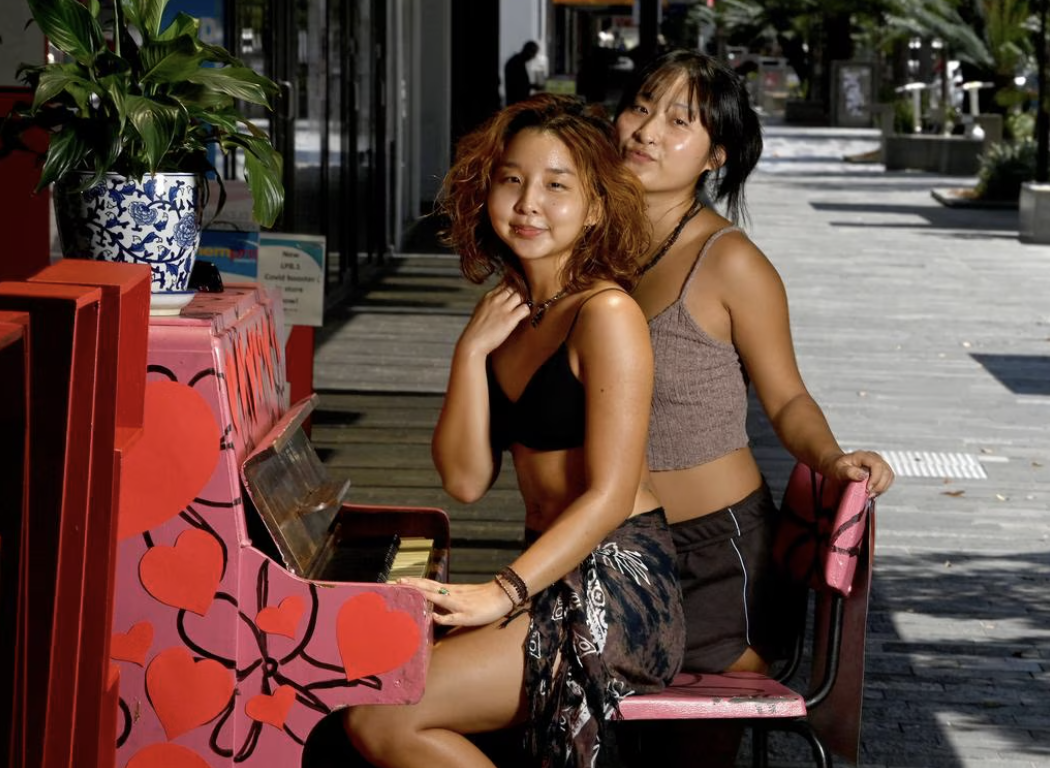
Its the middle of the day during the week. There are a group of retirees who come to connect and play a game of chess or mahjong. There is a mum stopped to let her beautiful daughter play the pink piano videoing it and sharing to her family around the globe. There are some cruise passengers purchasing some beautiful unique and quirky homewares to take home with them.
It's a Friday evening and the CBD is the place people are heading towards, not away from. A bunch of the 11,000 workers are sitting down to enjoy a busking competitition at Bulletin Square , Enjoying a drink at City Lane and perhaps participating in one of the Uptown Monthly initiatives. Residents and visitors are out and about, bumping into each other, discovering that new place that just opened.
Someone visiting from Brisbane or Sydney walks through and thinks, "Wow, Townsville is really something." Not, "Hmm, where is everyone?" Its so busy that it naturally detracts from anti social behaviour.
Shopkeepers have their goods on the footpath, cafe tables are spilling onto the pavement, Youth have found the first time as the place to be since the 80's. People are living in the CBD, not just commuting to it. And the whole thing feels unmistakably Townsville: unpretentious, warm, a bit cheeky, fiercely proud, and always up for a good time.
David Engwicht, the bloke who started out washing windows, figured out something that urban planners with PhDs often miss: you don't need permission to care about your street. You don't need a masterplan to put a chair on the footpath. You don't need a million-dollar budget to start a conversation with your neighbour about how to make your block a little better.
You just need to start. And that's exactly what UpTown Townsville is doing. The heart of Townsville is worth fighting for. Let's get cracking.
To get involved with UpTown Townsville, visit uptowntsv.com.au
Sources: ABS Census 2021; ABS Estimated Resident Population 2024; Knight Frank Office Occupancy Survey (December 2024); Townsville City Council; Mirage News; UpTown Townsville / BDmag (April 2025); Townsville Chambercast Podcast (April 2025); Jan Gehl, Life Between Buildings (1971/2011); PNAS, "Exploring the social life of urban spaces through AI" (2025); Placer.ai, "How Downtown Sacramento Is Rebuilding Demand Through Social Collisions" (2025); Gehl Institute, "Pedestrian-Friendly Streets" (2024); Project for Public Spaces; Jane Jacobs, The Death and Life of Great American Cities (1961).